Bigger Than Nations

Hi everyone - quick note about some upcoming events in North Carolina and County Down & then some thoughts on what we really are. Feeling a bit ambitious today.
Black Mountain, NC - Friday 16th May: John Francis O’Mara
We’re delighted to support this concert with our brilliant friend John Francis O’Mara - an Americana musician with heart and guts, and full of Celtic spirit. If you’re in or near Western North Carolina, we’d love to see you there.
It’s at the wonderful White Horse Black Mountain, at 7:30pm - and like everything the White Horse has hosted since Hurricane Helene, the ticket price is pay-what-you-can (scroll to the end of this newsletter for a ticket link).
And in just six weeks from now: Kilkeel & Cultra, Northern Ireland, June 20th-27th
Ireland Retreat co-hosted by Gareth Higgins and Brian Ammons, with special guests Over the Rhine (Karin Bergquist and Linford Detweiler)
There are still a few spaces left on this retreat with our dear friends Linford & Karin, whose work as Over the Rhine is beloved as an exquisite imagining of who, where, and why we are. Details at www.irelandretreats.com.
Meanwhile, I’ve been continuing to think about the philosopher of religion Jeffrey Kripal’s delightful and haunting book How to Think Impossibly, which aims to help us see how “the impossible is a function not of reality but of our ever-changing assumptions about what is real.”
I’m fascinated by the notion that bringing “the impossible” into the field of what we consider possible, perhaps strange, but available in the field of human experience. Among other things, it encourages the fake cultural divide between “sacred” and “secular” to collapse once more, allowing for necessary and inevitable components of being human (such as prayer) to be liberated from false binaries.
And it calls forth an experience of the imaginal - where what has been and what is are mingled with what is to come, and dreams really do come true. This book is unlike any I’ve ever read, and might have something to say about all of them.
How to Think Impossibly resonates with thinking about the act and purpose of keeping a diary, while also reading the fourth volume of British comic actor and travel journalist Michael Palin’s Diaries. I’ve been reading him since he was “in” 1969, and I’m about to finish 2009 - a strange pleasure to have a four-decade-long privileged glimpse into another’s view.
Using a diary to record the events of a day is one thing; better, of course, is to use it to reflect on our lives - how we are growing, or not; what we’re learning. It can seem vastly egotistical, or leave us feeling diminished by the smallness we perceive.
But that’s a matter of perspective too - I’m increasingly captivated by the idea that we are nested between the common and the cosmic good; and that any story - including a diary entry - must at least imply the existence and necessity of both. If our self-reflection doesn’t include the most mundane aspects of our lives and the most ineffable, the tiniest speck of everyday logistics and the most gigantic beauties and difficulties, then our storytelling will be hamstrung, stuck behind a starting gate that never quite opens.
With that in mind, I’ve been reflecting on how the peace movement where I grew up in northern Ireland is often unsure of its achievements - indeed, framing its self-evaluation in terms of “achievement” is part of the problem.
For years, decades even, a sense of low-intensity emergency pervaded our lives; for many of us, to be “anti-violence/pro-peace” had to be the priority, whether or not you leaned “pro-Irish” or “pro-British”. But because peace “comes dropping slow”, and aggressive-vindictive oppositional energy often sounds louder than the work of common good audacity, it often seemed to many of us in the peace movement that we weren’t getting anywhere.
But it struck me recently that the adage that you never know what impact your work is having until it’s over is both absolutely true, and absolutely not the whole truth. The peace movement in the north of Ireland was achieving things in and of itself, just by existing. It gave people a sign that the us/them, win/lose, Irish/British binaries were not the only options. Political change was necessary, of course: we definitely had to find a way to share power among all legitimate interests, and seek ways to make amends for the sins of the past; and the violence needed to stop - it was always wrong, no matter who was behind it, or the intent. But throughout the emergency, there were always people who decided to live as if oppressive and dehumanizing rules were made to be (creatively, non-violently) broken. Looking back now, I see that the peace movement was an astonishing embodiment of dreaming the kind of world we wanted to live in, without recognizing that we were already on the path.
But what is that path going toward? I’ve been thinking about the current misuse of theology by some public figures to justify mistreating people - specifically the Aquinan ordo amoris, . First of all, if love is worthy of the name, it will commit to never mistreat anyone.
Secondly, of course it make sense as a matter of psychological, social, and spiritual health to organize our lives with discernment about the focus of our affections and commitments, and the time and energy available to us. But this doesn’t mean that some lives are worth less than others.
Thirdly, not only does no credible definition of love include mistreating anyone, but it’s entirely possible to imagine the healthy boundaries of a community in ways that welcome the stranger, bind the wounds of the brokenhearted, ask for accountability, and invite amends for wrongs done or good things left undone without causing suffering to anyone. This truth needs to be spoken loudly, embodied vigorously, and championed audaciously. Love is not only stronger than death, but bigger than nations.
Finally, I want to say one thing about the recent threat of tariffs on movies made outside the US. I’m not an economist, and I want cinema to thrive - especially when artistic and technical craft operating at their highest frequencies, and a radical concern for the common and cosmic good kiss each other. I think the idea of making it harder for films from overseas to be seen in the US is ridiculous. Not just because so few movies are made and funded entirely within the bounds of one nation; but more importantly because it is a matter of love and death for more of us to try to see life through the eyes of others.
When we watch movies from places apart from the ones we call home, we dream the world, and the world dreams us. Other than literal travel, there is no better method for “touching” the ends of the earth than giving our attention to stories and light from around the world.
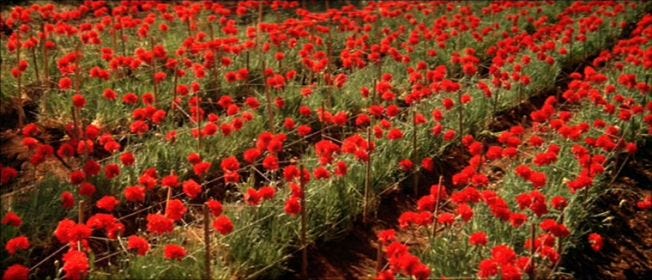
A case in point: I’ve been revisiting two of my favorite films, just released in a gorgeous restoration. French classics Jean de Florette (whose plot pivots on the flowers in the photo above) and Manon des Sources carry something like the depth and complexity of The Godfather; and are about similar themes: the definition of family and neighbor, the relationship between pride and interdependent mutual recognition, and what happens when you draw the circle of belonging to exclude rather than share with others. The ache in tragic stories is often about what could have been so different, and so easy, if only one person had made one different choice. Jean de Florette and Manon des Sources are among the movies from outside the US that have the most to say to any of us who wants to learn and embody what we really are: a little lower than the angels, made in the image of love, worthy of treating ourselves as we would want to treat others. There’s a very loud story being told that tries to make us feel unworthy, that our stories must be a constant battle, that some lives are worth less than others. It’s not naive to audaciously assert that (no matter how loudly that story is told) you, we, and I are ineffably valuable. Not only is this - quite simply - true, but it’s probably one of the two or three most important things any of us can do, not just in moments of crisis, but always.