
Magic Words
A Conversation with David James Duncan

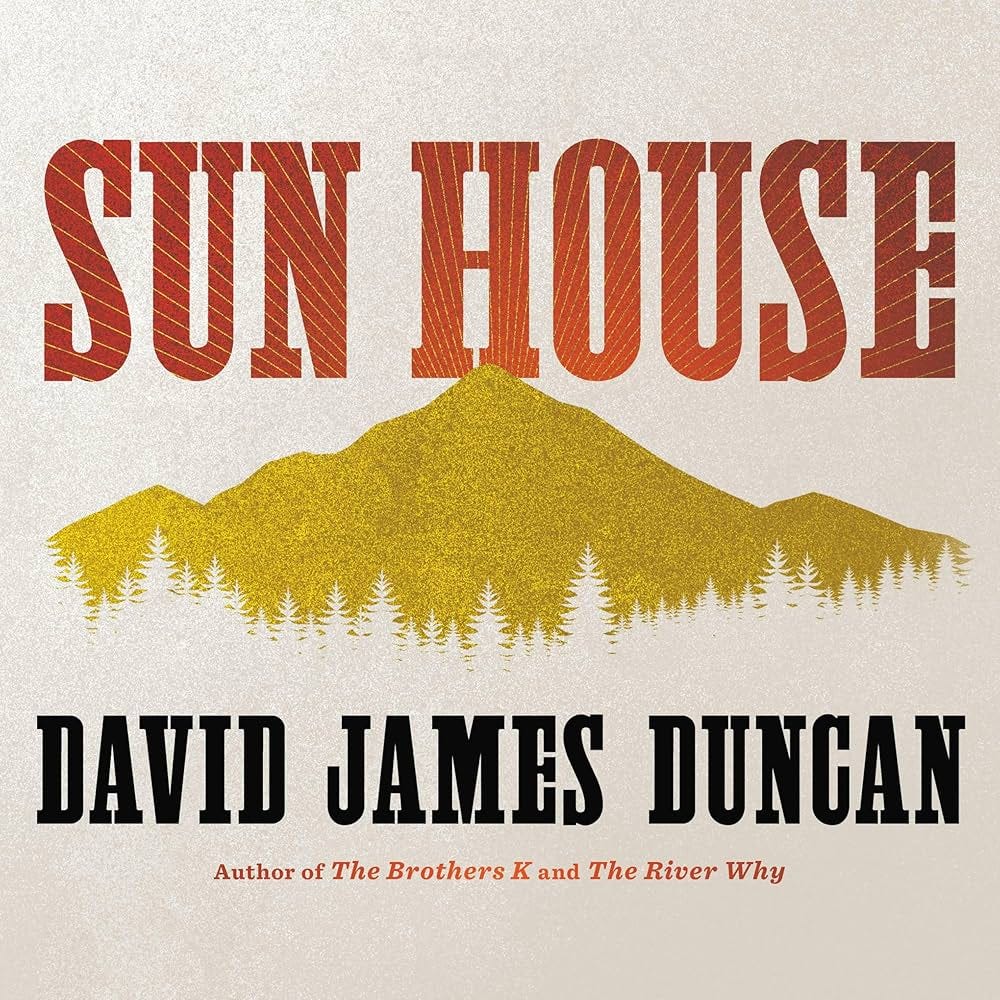
About twenty months ago a book fell into my lap that I imagine will stay in my mind and heart forever. When people ask me to describe David James Duncan’s novel Sun House I tell them it’s a story about people in the Pacific Northwest, and in Montana, who have something happen to them, and who then do something with it.
I don’t want to spoil the surprise that the thing that happens to them, and the thing that they do about it, might be among the things that each of us most want to have happen to us, right now, and for the rest of our lives. It’s set in what we might call the real world, but it has the courage to envisage a way of being in that world that neither bypasses the brokenness, nor lets itself be dominated by the uninitiated voices of separation, dehumanization, selfishness and greed. It wants to value all lives as of incalculable worth, it honors the incomparable gifts of spirituality - lived relationship with mystery, life as a practice not toward perfection but growth - both growing up and growing down into the metaphorical soil of spirit, wisdom, story and the literal soil without which our hands - and hearts - may appear clean, but will actually just be antiseptic, walled off from authentic experience. Sun House is a story about interdependence - interbeing, actually. It gave me language to describe things I’ve been dancing with for decades. Reading it - and listening to it - gave me more life, or more life to my days.
It’s a source of deep gratitude to me that David James Duncan is becoming a friend of The Porch, and will join us on one of our Ireland retreats this coming June. About half the spaces on that retreat are already taken, so if you’d like to join us on that retreat, now is the time. All the details are at www.irelandretreats.com
David would be among the first to note that none of us are worth more than any of us; and part of what we try to do at The Porch is to nurture a culture of mutual recognition not pedestals, in which every one of us is affirmed in our gifts and callings toward the common good. One of the things Sun House does is to tell a story in which everyone matters.
Today I’m delighted to share a conversation I had with David a few days ago - in it we talk about courage, creativity, the common good, and he shares a truth about how to be in the world at times of crisis. I hope these words offer some shelter, inspiration, and awakening to you.
A CONVERSATION WITH DAVID JAMES DUNCAN
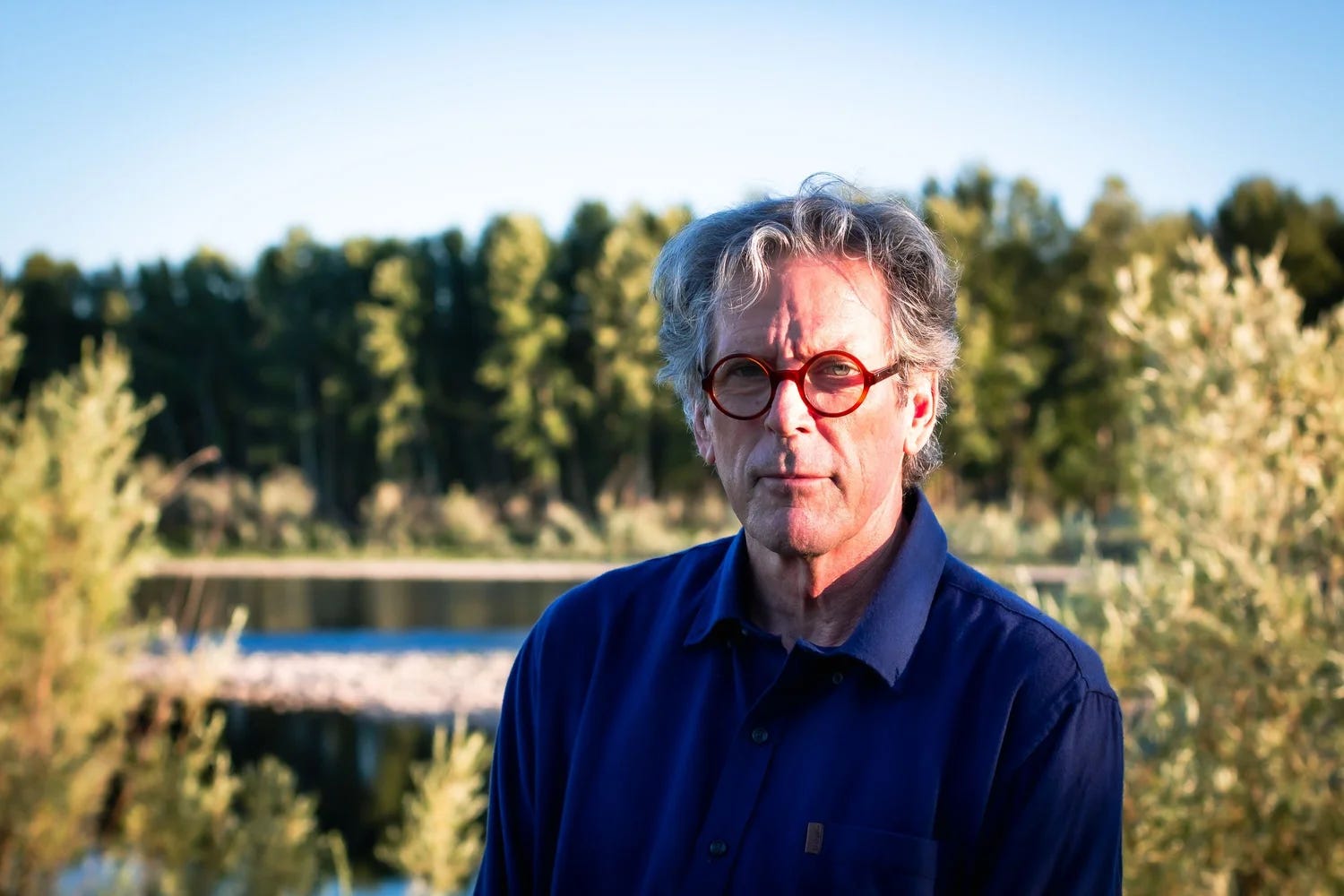
CLICK ABOVE TO LISTEN, OR READ THE TRANSCRIPT BELOW
Gareth: So David, I’ve said to you before that Sun House is the story I most want to live in. And when I said that to you a few minutes ago, you had an answer that surprised me.
David: I said it’s the story I would like to live as well.
Gareth: I have a sense that there’s certain kinds of writers who feel like the writing is being done through them in some way. And that kind of feels like what you’re reaching for there. [So] what do you mean when you say it’s a story you’d most like to live in knowing that you wrote it?
David: Because a lot of the time, more than with any other book, I mean, just the sheer amount of time, fourteen years, was huge. But I wrote things in that book that I think are beyond my ability. I think I kind of disappeared. An example would be the Queendom-Come Shards, where Lorilee is receiving prophecy from a lake, from this amazing jade lake that has a lot of limestone under it and was struck by a meteor. There’s an incredibly deep body of water that’s almost like a tube going down toward the center of the earth that was opened. And I was actually using the words that like there’s a magic inhabitant in the center of the earth where it’s, I think, 7,400 degrees Fahrenheit. And yet it’s her home because she is Sophia. She is what the Lûmi call the Gahan - Ka’isht. Well, what I said about her that I really liked was that it is as impossible for Sophia not to be creative. It is impossible for her not to be constantly creative as it is impossible for the sun not to shine.
And well, I like that sentence. I think it’s true. And you know, there have been six great extinctions that we know of. We’ll come back from this one too. I mean, something will, life will, an abundant planet will return. What’s up for grabs is whether humanity will survive in decent numbers.
Gareth: So that line you just said about it’s impossible for Sophia not to be creative - I have this view that the gift and the calling of every single human being is to participate in co-creativity in some way, but most people don’t believe that they are creative people. And I think even most people who are employed in what gets called the creative industries may not think that they are creative people. Knowing that most people are not going to become published authors or, you know, musicians with a recording contract or filmmakers who get to participate in what might be called Creativity with an Uppercase C, what would you say to people who are carrying the burden of thinking I’m not creative because I don’t have a book contract or because I don’t sing in public?
David: I teach a writing workshop [four times a year] that goes from morning on Friday through Sunday evening. It lasts three days. There’s a cottage here just across the driveway from where I’m sitting that perfectly holds eight people, plus Erin [colleague], plus me. So I teach a group of eight people. I’m thinking of these iconic sentences of Mother Teresa. I was looking at those earlier and I’m just going to recite them before I continue. She will sometimes just say these things very calmly and a friend of mine who’s a Trappist monk now, he was with her in Calcutta, on the streets of Calcutta with the Sisters of Mercy and with Mother Teresa and got to know her rather well. One of the things she said that really struck me was When I finally see Jesus, I’ll tell him I loved him in the dark.
[And here’s] another one: May God break my heart so completely that the whole world falls in.
And another one, this is my favorite.
We can do no great things, only small things with great love.
And I’ve found that I can teach eight people in a cottage across the driveway with great love and they feel it. And their responses are so beautiful that I won’t be reciting or I’ll start crying again.
They’re so appreciative and they come from all over the country, Florida, Maine, Virginia, Alaska. And I think it’s fulfilling to Erin and I as it is to them. And it doesn’t feel like teaching.
Gareth: And so do you feel that people have an experience of awakening a creativity that they didn’t know they had or didn’t believe that they had?
David: I’ve had several students who just said flat out I’m not a writer. And then they end up writing quite well. And right in the ad that’s on my website, I say that a lot of times there are people who have not discovered that they’re writers because they’ve never tried to do it creatively. And it turns out they can do it rather well.
Gareth: One of my yearnings is that everybody would know, whether or not they’re a writer, that they have a creative, I guess to use an old word, a charism or a gift within them. And most people just haven’t had it validated or called forth. I think my grandmother, Olga Lambe, I don’t know that she wrote or kept a journal, but every time there was a communion service at her Methodist church in East Belfast, on the Saturday the day before the communion service, she would go down and buy a loaf of sliced white bread and then take a pair of scissors and cut the bread up into tiny little squares. And she would walk down to the church. I went down with her a few times to do this. She would walk down to the church where she had been present on the day they had cut the first sod to build that church in 1957. And in the 80s and early 90s, I would walk down with her sometimes with a plastic bag that had these cut up squares of bread and a bottle of Schloer. Anybody in the UK and Ireland who’s listening to this knows what Schloer is, but if you’re outside the UK and Ireland, Schloer is like red grape juice with bubbles added to it. It was slightly fancy - it was fancier than Coke, and obviously had no alcohol in it. She would bring a bottle of Schloer and she would unlock the back of the little table where they would keep this and she would put it in there and then close it so that the next morning at the church service, the bread and the fake wine would be available. Now, that’s not the only thing she did in her life. But honestly, when I think about that, there was an art to her doing it. I think she would never have thought of herself as a creative person. And I regret if she never had that validated within her, you know, a necessary, imaginative gift to a community.
OK, so I would love it if you if you would read what might seem unusual for people to listen to. I think that one of the things about Sun House is even the acknowledgments section at the back of the book is a story in itself. And there’s part of that first page of acknowledgments that I’d love you to read. I’d love people to hear it and for us to to talk about what you’re saying there.
David: Acknowledgements in Four Stories. Seventeen years ago, in a world in which the problems facing humanity and every living thing had overwhelmed our politics and many a politician’s sanity, I came to feel the world situation is so darkly mythic, epic, overwhelming that only a collectively mythic and epic response stood a chance of righting the countless wrongs.
But though I’d seen countless op-eds calling for a change of consciousness if humanity is to survive, I’d seen zero op-ed descriptions of what this consciousness looks, feels, tastes, sounds, and lives like as it addresses inescapable biological and spiritual realities with the love, truthfulness, and justice they demand. This impasse set me dreaming of an outpouring of stories in what the praise poet Anne Porter called an altogether different language. I was suddenly attracted to tales that felt like walking El Camino in Spain, where it’s simply ordinary to befriend total strangers taking the same walk. We’re like a hundred day spiritual retreat in a place far from our species raging in asphalt and fumes, which at age nineteen I did in a mountain fastness I can still summon by simply closing my eyes.
I kept quiet about my new literary efforts, figuring many would consider me mad to attempt something so potentially optimistic in a time so dark. But as Mae Sarton once said, and I only know Sarton thanks to Maria Popova’s splendid blog The Marginalian, there is no place more intimate than the spirit alone.
Soothed again and again by that very intimacy, I began to marvel at how many of my friends still believed spiritual forces can be summoned with mythic, mystical, or poetic language sincerely said, because we’ve seen it done, or have once or twice done it ourselves, and the stories begin to come. Then they begin to intertwine in ways that increase their potency, and they didn’t stop coming for sixteen years when Sun House was at last complete.
Upon learning the manuscript was 360,000 words long, some of my friends laughed and asked who had time for what even my esteemed editor called this beautiful behemoth. In an age of governance by tweets and news shelled out by logarithms, while even the logarithms are rendered nonsensical by the invasion of clickbait and ads, my reply, “everybody puking sick of tweet governance and ad prostituted logarithms,” didn’t appease the skeptics. But as it turns out, everyone in these acknowledgments not only gave Sun House time, they thanked me for what it gave them in return, leading me to want to thank them, not with a rote list of their names, but with the brand of words I love best, stories.
I’ll just add that the students that come to these little workshops, something’s changed in the last couple of years. They’ve all read Sun House. So there’s this gigantic conversation underlying the conversations we’re having ⁓ that feels very present in the room.
Gareth: I’m looking forward to being part of conversations like that when you come with us to Ireland this summer. OK, lots of things jump out at me there. Only an epic and mythic response can meet the moment. That’s my paraphrase. And I guess it was twenty years ago or so that you were first having these thoughts that only an epic and a mythic response can meet the moment where I guess we would say there’s a bleakly epic bleakly mythic dominating story. I always think it’s a bit like Godzilla kind of just rampaging through the land. Now your response is not to kind of imagine another Godzilla who’s there to decapitate the bad Godzilla with more dominance [although] the response is epic and, and, and mythic.
And the two questions that are in my mind, first of all, is if twenty years ago you thought things were bad, like, I think a lot of us feel like, goodness gracious, we were concerned, scared, angered, despairing, ready for something to change and willing to participate in that change two decades ago.
And then it feels like two things have happened at once in those two decades, that lots of things have gotten worse. And I like to call it a frontlash rather than a backlash, that the energy of desire for transformation toward the common good and toward, love this word that I think, Thich Nhat Hanh coined of Interbeing that goes far, far [further] than interdependence. To me, it’s, it’s a sense of ever increasing union, not just with other human beings, but with the entire ecosystem. It seems like both things are happening at the same time. What do you think?
David: Yeah, I think the only administration I can think of that was as destructive as this one was the one Abe Lincoln oversaw during the Civil War. The loss of life, you know, was gigantic.
I can’t remember the exact number, but just at Antietam, one battle, I walked that battlefield with Barry Lopez and an amazing thing happened. We walked up to a cannon and a Robin shot between our heads, like right between our heads and went up the cannon barrel. And Barry walked over after she flew away and peeked inside and she had laid seven robin egg blue cannonballs inside that cannon. And it was a cannon that was going to produce a weapon called a robin, a variety of thrush that would travel farther than any weapon we could ever in its life would travel unbelievable distances and do amazing things. That was one of the more enjoyable walks I ever took that day with Barry on the battlefield.
22,700, I think, is the number of soldiers that were killed.
Gareth: So robins don’t have to be metaphors. They can just be robins. And I sometimes think actually when we try to use metaphor, metaphor needs to be handled with care because sometimes the literal fact is more than enough on its own. And with that caveat in mind, where do you see metaphorical robins right now?
David: Well, I walk a hillside where there’s a 900 foot elevation gain and loss in a two and a half mile walk that I take every day. Something I see often up there that blows my mind are Northern Harriers. They are big predators. They have this beautiful white on their rump and they glide almost without a wing beak, just really following the contour of the land and they will suddenly just do a flip and they’re flying in the opposite direction and then they pounce and they get a vole almost every time. They make that incredible move and it’s just so gymnastic for such a big bird to be able to fly that deftly and that deadly. It’s a skill that voles wish they didn’t have. And to me that could be used as a metaphor for lots of things, but so many things in the natural world to this day, despite how reduced it is, are so incredible and so beautiful to watch, so beautiful to understand if you’ve really checked them out for years. I’m getting up there in years. I’ve been around for a long time. It doesn’t need to be a metaphor because what it’s doing is so beautiful, so skilled. Why add literary techniques to that, to just describe what happens is satisfying?
Gareth: Thank you. Well, at the risk of sounding like I’m responding in opposition, I’m not. This is just kind of an allied thought. I think I read somewhere that Jim Harrison encouraged you to try to turn into a river. Am I getting that right?
David: He ended up in one of his poems - and he told me this too - he said he wanted to finish his life disguised as a creek. And he talked about joining the flow at night and swallowing himself endlessly. And Jim is associated with some rather famous meals. I think Jim could swallow himself!
I was very fond of that man. Boy, he was fun to be with. The way I put it in a little essay about him, when he died, once you spent time with Jim, he just exuded genius. But I said, he also had incredible problems. And I feel that his problems were also geniuses.
I don’t think Jim would argue with that.
Gareth: So help me understand that last piece. First of all, I’m feeling this sense of, the place where I’m sitting has a lot of windows. I just literally saw a bird just fly past the window just as I turned to the right there. I’m really drawn to the idea of putting a consciously chosen force-field between me and the impulse to metaphorize everything I see.
I just enjoy the birds for being birds at least, at least some of the time, at least some of the time. I’ve often thought about Mary Oliver’s astonishing and repeatedly recited poem that ends with what will you do with your one wild and precious life? And I think about how often I’ve heard that poem recited and how rarely I’ve been in a conversation in which people have actually felt empowered to answer the question. What will you do with your one wild and precious life? And I would imagine that Mary Oliver in the next life, wherever she is now, is wanting people to read the poem, listen to the poem, but let the poem work on you. And I think this goes back to my grandmother and to other folks who have not had their own creativity validated. I want to say to people you are entitled, you are actually entitled to ask this question of yourself. You do not have to be “a poet” to ask poetic questions or to feel like you deserve to ask yourself, what am I going to do? That my life is wild and precious too. And at the same time, these birds, I mean, there’s loads of them flying around the window at the moment. There’s a time to just let them be birds.
David: I have a poem by Rumi in my hand that is perfect affirmation to what you just said. It’s called Love Dogs.
One night a man was crying, Allah, Allah. His lips grew sweet with the praising until a cynic said, so I’ve heard you calling out, have you ever gotten any response? The man had no answer to that. He quit praying and fell into a confused sleep.
He dreamed he saw Khidr, the guide of souls, in a thick green foliage. Why did you stop praising? Khidr asked. Because I’ve never heard anything back. Khidr says, this longing you express is the return message. The grief you cry out from draws you toward union.
Your pure sadness that wants help is the secret cup.
Listen to the moan of a dog for its master. That whining is the connection.
There are love dogs no one knows the names of. Give your life to be one of them.
Gareth: So you say in that first page of the acknowledgments - and you’ve already illustrated it - you say the brand of words I love best: stories. Do you remember what story or stories touched you first?
David: Yeah, I was seven years old in the second grade. And the teacher invited us all to write a story. And we had been writing for less than a year. But she invited us to write a story. And we all had this oversized green pencils that were in public schools in those days. I started writing a story that was trying to solve the riddle.
I knew that Christmas was Jesus’ birthday and I knew that he had an invisible father who could not be seen. And how does the invisible father get a present to his son, Jesus? And I think the next sentence in the story is, Jesus ran to the house and ate his breakfast. And then he went out. He did exactly what I would have done, what I have done. He went out into wilderness and his sheep, her name was Deborah, but the way it was spelled was D-E-B-O-R-E-H-A. And so I pronounced it Diborja. So when I read the story later, it was a little embarrassing. Diborja. Anyway, Diborja has gone out in the night and had a lamb. So that’s the present. And then Jesus remembers that the previous Christmas when he was six, he found a sparrow with a broken wing. And so it’s just a continuation. If you sit home like a child of divorce, being grumpy on the couch, nothing good can happen. If you go out in a wild place untrammeled by man, ⁓ something good might happen.
That’s been true for me thousands of times, especially on rivers and mountain ridge lines. I mean, [I spent] 100 days at 7,500 feet in the Wallowa Mountains when I was nineteen, just joy after joy.
Gareth: I think a lot of us, when we look back at the stories that entered our lives in formative years, that have then stayed with us, that there’s some element of like, nothing has changed and nothing needed to change. I’ve just gone deeper into this same core thing that was revealed to me. And I don’t know what the chicken and egg is.
I’ve often shared with people that when I was eight years old, my mother took me to see the movie about Gandhi. And, you know, like, why do you take an eight year old to see Gandhi? I asked her, I mean, that’s that’s over 40 years ago. I asked her a couple of years ago, why did you take me to see Gandhi? And she said, because I thought it was important for you to know about this great man and all the wonderful things he did. And I thought, all right, it’s it’s not rocket science.
But what that did for me - it did at least three things. The first thing was actually a recognition that movies could be more than cartoons and so-called kids’ movies, which were all I had seen up to that point in my life. The second was this thing called India. I had heard the word India, but I didn’t know what India was at eight years old in Belfast. There was a sense of this expanded world and seeing this place that to the degree that Richard Attenborough’s illustration of that place is accurate. And I know you have thoughts about that that are really striking in Sun House, but there was this sense of like, there’s another world out there. And there’s these people who are so different from me. And at the same time, we’re exactly the same. And then the third thing was it was probably the first portrayal of courageous activism for the common good that I had encountered, that there was this one man and these people around him who tried to contribute to ending something wrong and embodying something good, and that there was a spiritual heart to this as well. Now when I was eight years old I don’t think I would have articulately laid it out like that, but I have a very, very strong memory of going to that cinema, a very strong memory of seeing that film and of being changed by it. And those three or four dimensions - first that movies can be meaningful and that art can be meaningful at a metaphysical level. The second thing being that there is a bigger world out there in which everything is different and everyone is yet the same. The third being people in throughout history, some people have given themselves over to the common good and you can do that too. And the fourth being there’s this thing called spirituality, which is actually woven into the fabric of our lives. It’s not separate, you know, religion and science, politics and culture are not separate entities. They’re all woven in together. That that kind of came into my consciousness in 1983 when I was eight years old, right?
And it’s not a badge of honor. It just landed on me, just like your Jesus story landed on you when you were seven. It’s no longer a matter of concern to me what the chicken and egg is. It doesn’t really matter. What matters is this kind of became the story inside me and the story that captivates me, compels me. It’s the story I measure myself against and find myself lacking.
Hopefully no longer do I beat myself up over how much I’m failing. I just experienced life as an opportunity to continue growing.
David: And live Mother Teresa’s We can do no great things, only small things with great love. That’s my guide when I teach.
Gareth: And I think what’s astonishing about that statement is the intricate focus of one life; and small things done greatly is actually an astonishingly vast thing to say. I don’t want to get too utilitarian about it, but it’s achievable. It’s achievable to do small things with great love. It’s achievable. What are some of the other stories that wove into your life that kind of felt like a mirror for you?
David: I don’t know why it moved me so much, there was a movie about John Paul Jones, the Revolutionary War commander of the very few ships that the colonies owned, whereas the Brits had the British Navy … And when his ship was sinking, he yelled something very close to We have not yet begun to fight. They just jumped off the ship onto … the ship that had pulled up alongside of them and sunk them with cannonballs or whatever. For some reason, I guess just because it seemed impossible.
So I’d had this sinking feeling and then suddenly they have a better ship than they had before because they’re crazy mofos.
Gareth: So what is it about We’ve not even begun to fight - knowing that you’re not an advocate of violence?
David: Yeah, not a combat kind of activism, but I’ve done some really big projects as an activist, take on a Canadian mining corporation that was trying to put in a sign at Heat Bleach Gold Mine on the Big Blackfoot River. And I broke that story. And it took a year and a half out of my life because I kept feeling I had not yet begun to fight because we weren’t getting anywhere for a while. When I knew that we were going to achieve victory. was like a bunch of ranchers were worried about the mine because all these activists, like my friends, various river protection organizations, were just watching the Blackfoot, like, hawks to see how much water was being used. So suddenly the ranchers were being watched, and they hated that. They liked the freedom that they used to have. And so they joined the flight. And when it reached the point where the Cowboys were for us and the Indians were for us and the Rotary Club of Missoula was for us, I knew we were gonna win.
Gareth: So what’s a fight or a tactic or a path that you feel maybe right now we haven’t yet really begun it?
David: Adoration of the planet and the fact that we got nothing without this beautiful earth and so many people are treating it with unbelievable blind selfishness and greed and wreaking havoc. there are technologies now that are so horrible that I’m not going to dwell on that. [But when it] comes close to me, then I do take action. The second really big project I got involved in, wrote a, Speed wrote a book in seven weeks. Rick Bass took on Montana politics. I took on what happened when these mega loads from Asia entered the Columbia River and came all the way up four wild and scenic rivers that Exxon Mobil was blocking and thought we should be grateful to them because they were bringing lots of tar sands gasoline down to the states and that’s still going on. There are gigantic tar sands oil trains that go by the nearest railroad track to where I’m sitting now.
The story I told was the creation story of the Nimiipuu, the Nez Perce people. It’s called The Heart of the Monster. And it’s about a monster that lived in the previous age of the world that just ran around devouring every creature that lived. so Coyote got himself cleaned up and he was like, Yoo-hoo, monster. the monster ate Coyote and ⁓ as Coyote was going down his gullet, he passed Grizzly Bear. Grizzly Bear like roared at him and Coyote just punched a Grizzly Bear in the nose and that’s why Grizzly Bears have a short snout. And then someone stepped on Beaver and flattened his tail - you know, all the traits that various animals have.
Coyote is countering them, but he also brought flints and obsidian blades. And so he just went down into the monster’s gut and started sawing at the heart to get it to fall. It seems like there was a big opening inside the monster and the tribes have committed, it’s a very strange place because what the kind of basalt we have here is columnar basalt, which is very geometrical. And the heart of the monster is a huge pile of basalt rubble. It would have filled a ship. It would have filled a battleship. And it’s just lying helter-skelter. so it seems like something from space or something dropped this huge thing and broke it to pieces. that place where the monster’s heart is, is the creation point of the Nespers people. So it’s both, I always felt the story, the myth was both a prophecy and historic, know, ancient history, but both things. I still feel that. And I think the monster now is the corporations and I think at some point that’s going to change.
Gareth: I don’t want to lose something. He said it a couple of minutes ago, but by the kind of overture for what you just said, I think it really, I want to sit with it and I’m sure there’s people listening. want to sit with it as well. When I, when I asked you, what’s the, what’s the fight that we have not yet really even begun. Right. And your answer was adoration of the planet.
Adoration of the planet. It’s not, that’s not a typical answer to what is the fight we need to participate in. And I think you speak to something that has been for a lot of us. We maybe haven’t had a language for it yet. Some of us often quote the Franciscan teacher, Richard Rohr, who says the best criticism of the bad is the practice of the better, because oppositional energy always recreates itself. And that doesn’t mean that we should never engage in oppositional tactics. Sometimes we do need to stand in front of a bulldozer. Sometimes we do need to snatch someone’s hand away from the fire. But probably to a factor of 10 more than that, we need to step in to the creative thing. And I want to, I want to, I mean,
You may not even need to say more about it, but I just wanted to acknowledge that your response to the question about what fight have we not begun yet? Your answer was adoration.
David: Yeah, there’s so many people define themselves in ways where there’s no spirituality at all. And I had a terrible, wonderful experience, both things. When we first moved to Montana, Adrian and I were in a, we had an old canoe and we were taking our daughters, when Celia was three years and 11 months old and Ellie was a year and a half old and we were floating down the Bitterroot River and and Celia noticed well it was right near us on the bank a doe had been shot by somebody and run down to the river and its head was underwater and its body was very beautiful lying there but its eyes were had become a cloudy blue.
And Celia looked at it for a long time and then turned to Adrian and said, is it dead? And Adrian said yes. And Adrian has wonderful doe-like eyes and so does Celia.
Next, Celia asked Adrian, are you gonna die? And Adrian said, yes. She’s a truth teller. And then she said, is daddy gonna die? She’s like getting desperate now, know, grasping for straws. And Adrian said, yes. And then came the fatal, am I gonna die? And Ellie was shooting tears into the river.
They were traveling like two feet. She was crying so hard. And ⁓ Adrian turned to me and ⁓ we always had this difference. Adrian is uncomfortable about sloppy talk about spirituality and would rather just skip it. And I won’t go on too much more about Adrian, but she turned to me. And she’s a wonderful sculptor. She makes these gorgeous sculptures of women covered with textures of wild creatures or certain, like she makes beautiful women out of honeycomb that look like something that bees made and incredible pieces. But anyway, she just looked at me and she looked like a sculptor herself. She’s like, our little girl is devastated.
I don’t know what to say to her. So, word man, you’re on.” And I said, “Celia, look at me. Please look at me. I know that doe’s body looks very sad and it’s too bad. They run down to the river when they’ve been injured or chased by a predator and it looks sad, but incredibly, it’s way less sad than it seems, because that doe has left its body, which is wrecked. And it’s traveling around something Tibetans call the clear light now, and it’s looking for another creature to inhabit. And the same thing happens when a logger cuts down a tree. There’s some essence of tree that becomes something new. I mean Celia turned into a different kind of sculpture. She just looked like the title of the sculpture was, whew, that was a freaking close one. And and ⁓ a short time later we were we were sitting on our back deck. We had a fifteen year old Chesapeake Bay Retriever who was on its last legs and a Dalmatian that was healthy.
But as we were just sitting there, Celia was just trying to get the mathematics of what might be the order in which our family of four dies. And so of course she wanted me to die first. And I said, I’m not dying. Only my body’s dying. I’m not going anywhere. But at some point in our conversation, Clara let out this global disaster of a fart. Celia turns to me with a perfectly straight face and says, Clara is teaching us to believe in the invisible. I felt like she metabolized the word soul pretty darn well.
Gareth: Well, I’m just going to say adoration again. Adoration is the word of the day. It really should be the word of the era. It’s the it’s the invitation. We have these questions in in the community that that hosts these conversations, the porch community with the we call them porch circle questions. Sometimes people actually literally gather in circles and they ask these four questions. We we’ve found them to be tried and tested ways of helping people connect with each other and and and I think with a with a richer sense of of life and and meaning - and I’m skeptical of the word purpose because it can feel too much like industry and productivity. But maybe meaning is enough. But before I ask you those questions, would you read this first quotation that you have in Sun House called Magic Words? ⁓ Because I, you know, this is how the book starts. And I think it’s one of the many things in the book that is absolutely true.
David: The speaker is named Nalungiaq and she is an Iglulik female elder of the 19th century. Magic words are the most difficult to get hold of, but they are also the strongest. Magic words or magic prayers are fragments of old songs or apparently meaningless sentences heard in the days when animals could talk and remembered ever since by being passed from one generation to the next. In the very earliest time when all spoke the same language, words were potent and the mind had mysterious powers. A word might suddenly come alive and what people needed to happen would happen. Nobody could explain it. That’s just the way it was.
Gareth: I wonder if one of the reasons that magic words are the most difficult to get hold of is because lots of us use more words than we should. And I suspect people who know me are kind of hopefully gently laughing at me right now because I come from a culture in which we’re sort of genetically predisposed to use lots of words. But assuming that there are such things as magic words and that if we really allow word and spirit to dance with each other. Here’s four questions that you’ve generously agreed to try to respond to. The first one, David, is what are some of the things that you’re finding life-giving these days?
David: Well, I think the title of this conversation could be adoration. To actually spend the time, I’m at a window here with a huge ponderosa pine tree next to me. And five months ago, a little Douglas squirrel started harvesting maple keys and pine cones and all kinds of things. And it’s been doing that every day for five months.
Sometimes it has to run off a red squirrel, another kind. It’s introduced species here, but the little native Douglas squirrel. When he runs up that tree, he or she, he runs up the tree using these tiny little nub branches ⁓ and he rises up as fast as a flicker can fly up the same tree. He’s unbelievably skilled at running around in the in the heights of it. It’s a 100 foot tall Ponderosa pine and this little guy is the master of it. Anything like that, you know, I already mentioned the Northern Harriers that I love to watch do their kill dives. In the spring sometimes we get a few Sandhill cranes that are migrating back to Alaska from California and they’ll stay a few days. The year of COVID, they actually nested. was on a different, I was living on a farm then, and they nested in this huge field next to the Bitterroot River, right below where I was working every day so I could watch sand hills. And there were a lot of, a lot of coyotes. There was a choir of them that was singing every night and I was worried about them, but then I found out cranes have a dagger beak and they know how to use it. So just the variety and these seemingly opposed creatures. You know, a young Sandhill crane is called a colt, as if it were a horse [and] that choir of young coyotes that were just learning how to howl together, it sounded like 25 animals, but it was probably fifteen. The colts have such opposite needs, but they were able to live in harmony for that whole summer. Other things happened too. The trumpeter swans were flying right through the cottonwood trees, right outside my window some days. They have a ten-foot wingspan. And you just see the 10-foot wingspan on a trumpeter. And if you’re not experiencing adoration there’s something wrong with you.
Gareth: So if adoration is what you’re finding life giving, what are one or two things that you’re finding not life giving? we always want to, you know, there’s a caveat to that question. These first two questions, what are you finding life giving? What are you not finding life giving? They’re adaptations of the spiritual exercises of St. Ignatius of Loyola, a highfalutin name, but a down to earth guy, deep, deep, deep, deep, into the earth. And the way, as you know, the way he would ask those questions is what are some of the sources of consolation in your life and what are some of the sources of desolation in your life? And I think often when we ask each other, how are you doing? Like these days, I never know what to say when somebody says, how are you doing? It’s become sort of a synonym for hello.
I like to speak about what I’m finding to be sources of consolation, what I’m finding to be sources of desolation. But to talk about the source or to talk about the thing that I’m finding not life-giving is not the same thing as to give myself over to the despair. It’s simply a way of describing it and naming it so that people can know me better, maybe that we can see each other better. It’s not the same thing as feeling that despair. think sometimes be a way of releasing some of it. If you would share with us, what are some of the things you find that are not life giving to you?
David: Anything having to do with national politics at this time. America is just taking huge hits. I think we’re also probably bankrupt. And ⁓ it’s just dreadful to spend much time on that. The Washington Post sends their headlines and I will read those headlines in like two and a half, three minutes and that’s it for me and politics that day. I’m not effective if I’m thinking what can I do to stop mumping trust as I like to call them ⁓ and the answer is nothing you know and if they could hear me they would just disagree with everything I’m saying and so why think that way? And I just feel sorry for journalists because man, read poets, not journalists. I mean, they have to tell you what insane people are doing and that’s a rough job. And I feel for them.
Gareth: I think one of the things I find not life-giving is the sense of before I even think about something, like let’s call it the news, which I think, you know, it’s a kind of a false description. It should really be called the olds because what shows up in the news is repetitious spectacle about awful things and how to face it. And without being an irresponsible person or ignoring it or bypassing it. And at the same time, falling under its spell is an absolute distraction that not only is an unpleasant experience for me subjectively, it totally takes me away from what I might be doing and living that could make a contribution to the world. with that kind of in mind, the third question we like to ask is, what is a better story that you feel called to? Or what are some of the energies in the world that you feel compelled to claim more of for yourself and for the others whose lives you do touch?
David: A hero to me is Thomas Merton. And ⁓ I’ve read a lot of his work, but ⁓ what I want to get at is that Merton had an adage that I really took to heart when I was young, that said spiritual secrecy is the protector of spiritual integrity. And I found a spiritual master that I adore when I was 16 years old, and he’s been in place for me ever since. And no, I won’t tell anybody what his name is or where he lives. But it’s unbelievably consoling to me.
He’s written some of most beautiful prayers imaginable and with kind of universal appeal. So he really is someone who at some point, probably in a pretty distant past, allowed God to break his heart so completely that the whole world came in.
it’s just, yeah, it’s just that I feel bad mentioning someone that I’m not comfortable naming, but I also feel like it protects the integrity of the relationship that we are in, even though he’s not in a visible body. It’s an intense relationship. And I repeat his prayers. I know a lot of songs I can sing about him.
And he’s got a lot of followers, but he’s still laying low, which I like.
Gareth: Well, mean, I think you’re talking about like, you know, a better story and it’s a rare story, at least in what used to be called Western or certainly Eurocentric culture, that some secrets are matters of life and death and that there’s an invitation or an encouragement to the rest of us that there might be some, there probably are some things that are so precious that they will only grow deeper to the degree that they are held very, very close.
David: I would say many of the teachings of Thich Nhat Hanh fall in that category. He met MLK. I would like to have heard that conversation. Maybe it exists somewhere, I don’t know. But those men are highly advanced souls.
Gareth: And they didn’t always publish everything they thought.
David: Yeah, right. Yeah.
Gareth: Yeah, not because they were hiding it, but because the depth like is so I mean, I think that’s a profound thought that you have a you have a teacher and I’m not gonna I’m not gonna try to get you to say it seems to me that the depth of what of what that relationship has done for you is deeply related to the degree that it has been held in the hermitage of your own heart.
David: Yeah. And it - it is almost impossible for me to despair.
Gareth: Wow. Tell us the secret of that.
David: Well, there are people in the world who might know everything. You know, I’ve got Edward Abbey sitting over here saying, God is love, not bloody likely. That’s Ed’s cross to bear, but he also had an integrity about things too. And he was a person of substance, [who] just had a rustic personality. We don’t share the same sense of humor, but he also made me laugh when I was reading The Monkey Wrench Gang. He has a character who he establishes that his nickname is Rudolph the Red. [Something] like 300 pages later, he’s walking in the desert with this woman and he says it’s going to start raining even though the skies are clear. And she asks how he can know that. And he says, this is the whole reason he had that name. Rudolph the Red Nose Reign, dear.
Gareth: So I’m not sure that that is a there’s a direct through line between you saying it’s almost impossible for you to despair, and that there are some people who may know everything. [Laughs] Along with, along with Rudolph the red, why is it almost impossible for you to despair?
David: I had an older friend, he’s still my friend. He’s in New Mexico now, but he lived, he went to Stanford University and we avidly wrote letters back and forth to each other. And one of the letters he wrote to me, he had this sentence, I refuse to kiss the rancid ass of despair. And I think that’s not a bad description of what we’re doing when we surrender to despair.
And I don’t want to be kissing no rancid ass, that’s all. Sorry, it’s not more profound than that.
Gareth: All right, last question. And in a sense, this is the heart of all of our conversation. We like to ask people, what would you like to offer others? And also, if there was support that you need, and I mean, God knows all of us need some support. What would you ask for for yourself?
David: I have wonderful support. My friend who is friends with Cesar Chavez and Mother Teresa, he’s a Trappist monk and he lives a day’s drive from me, so it’s a haul. I I know this man so well. We went to India together. ⁓ I met him on the very first day of college. ⁓ And ⁓ we’ve just been like that ever since.
Most of what we do when we walk around the Abbey where he lives ⁓ is make each other laugh ⁓ because the world is just so strange.
Gareth: Laughter is part of the antidote to the rancid ass kissing.
David: Well, just to know someone that well, for as long as we’ve had, more than half a century, we’ve been very, very close. And ⁓ he’s my spiritual brother, there’s no other way to put it. I mean, it seems to me like this, where you experience support in your life is in deep relationship, enduring conversation. And somebody said to me once to learn to take life seriously without taking yourself too seriously.
My days are solitary if I work a full day and I almost always do. But in the evening, ⁓ there’s a couple of restaurants I frequent. And I mean like really frequent because I just want to be around the sound of the bizarre noise and meaning that just even little chunks of conversation that I’m picking up from people who don’t know I’m listening to them. But I really enjoy that and a bunch of the people at this restaurant have become dear friends. I love both my last two landlords. And that’s a little odd. They’re wonderful people.
Gareth: So what’s one thing you’d want to anyone listening if there’s only one thing you can say to them?
David: Just one thing. What I told my daughter, the soul is indestructible. You’re in it for the long term in ways that you don’t know about yet. But a friend of mine, Tom Crawford, has a wonderful book called Be Broken to Be Whole, Book of Poems. And one of the things he says in that book is that when people die,
The interesting thing about dying is you’re not dead. ⁓ So you get another chance of some kind. ⁓ I think karma is real. I would be careful, you know, try to be a moral person, try to be kind all the time, try to be compassionate all the time. ⁓ Things crop up the same way you see a cool bird where you could be showing a person who maybe looks a little devastated some kindness and I try to do that.
Gareth: We’re going to Ireland together in the summer. There’ll be a bunch of people coming with us. The porch community takes folks to Ireland where I’m from every summer to have a bit of a deep dive into the landscape, the culture, the story of conflict transformation and peace building and reimagining our lives and our place in the world. And I’m just overjoyed that you’re coming with us. I’m interested in what you might be looking forward to about that.
David: Well, I look forward to meeting people, new people who are interested enough in this thing to travel a hell of a long ways.
I have lots of stories if you ever want stories. A lot of them are in the mood of ⁓ we can do no great things, only small things with great love. And in the stories I like to tell, a lot of times the story will be half dark and then some unbelievably beautiful cause of joy will arise unexpectedly. And I like sharing stories like that because they’ve happened to me.
Gareth: David, thanks for this conversation. It’s a beautiful, enriching experience for me. Thank you.
David: You’re welcome. We’re going to have fun in June.
PS: When I asked David if there was an extract of Sun House that he especially likes to read aloud, he offered the following scene, emblematic of the magic of this extraordinary book. I have found so much grounded hope in reading Sun House - a wildly imaginative embodiment of the consciousness, community, and creativity that The Porch aims for. I hope you’ll listen to David’s words, I hope you’ll consider joining us in Ireland in June (www.irelandretreats.com), and if you can’t make it that far, the April Porch Gathering in North Carolina awaits.
And now, David James Duncan reads from Sun House. May you find some of the enormous shelter it offers.
It feels appropriate to type a reminder of the last line of that extract: God I love the things that man says, and feels…
Please find more of the astonishing Sun House at www.davidjamesduncan.com/sun-house; and if you want more transformative storytelling, in a spirit of courage, creativity, and community, we’d be glad to have you.
Love this book with all my heart. It guides the reader to move through Life integrating suffering, union, communion, and agency. One of a kind. And from other interviews I watched with Duncan, his tears testify to the interior life to build such a piece of art.
I look forward to listening to y'all's conversation, Gareth.
Am on page 51 and savoring every bit of this book already. Those going on retreat with you and David are in for a treat ❤️