
What Advent Could Mean
Even if it's not your thing...

LISTEN TO AN AUDIO VERSION OF THE INTRODUCTION & ADVENT BLESSING HERE:
I’ve been wanting to write something about Advent for The Porch, knowing that some of you magnificent Porch readers mark other traditions or none at this time of year. To you I say welcome, and thanks for sharing in this conversation. I love to learn from you about your traditions and experiences, perhaps especially how this time of year can be more inclusive across lines of religious, ethnic, and cultural diversity.
I’m also aware that folks often confuse Advent with Christmas. I used to be one of those folks: I didn’t understand until recently that, in the tradition that has adopted me, Christmas actually begins on December 24th and runs until Epiphany on January 6th. (I’ve often mentioned that the Dalai Lama was apparently once asked what US Americans could do to make the world a better place. Go to bed when it gets dark, and get up when it gets light. The answer to the hardest questions is often no more complicated than learning to move with the grain of life, and of life-giving traditions. For me and my house, I think that letting Advent be Advent and Christmas be Christmas will be one of the things that saves us.)
I know many of us feel the tension of how our shared culture does Christmas; how it trivializes reality, equating the rush to buy more metal and plastic things with the ineffable astonishment of Being itself, not to mention the immeasurable, ungraspable, multidimensional experience of being made of and for Love.
Don’t get me wrong - I love gathering with friends and exchanging gifts at this time of year, the warmth in the communities I am grateful to know and be known by, the smiles of recognition when unwrapping a gift from someone who truly sees me.
That exchange - of gifts and gratitude - is both an end in itself, and it is a symbol of so much more. It’s supposed to be part of a circle of interbeing, in which not only are gifts given, but needs shared, and the circle expanded to include everyone, especially those whose needs are acute.
So this is what I want for you, for me, for all of us, not just this next month, but in the elemental core of all moments:
An Advent Blessing
In the tradition that holds me
The animating event of history is the eruption of divinity into the human
It’s ok if that’s not your tradition
I offer it as poetry, not imposition
So, where I come from, right now it’s Advent
The coming of that eruption
And what it means
Or one of the things it means, because its meaning is inexhaustible,
Is that Every One Of Us
Matters as much as sparrows and seascapes, symphonies and silences
The smallest love and the largest imaginings
Bodies held by Soul, Soul held by Love.
None of this is unrealistic
None of it less important than the world of “things”, of “admin”, of forgotten passwords and stressfully remembered to-do lists
None of it too weak to answer in the face of suffering
All heroism begins with the kind of love that everyone reading this can feel for others
All suffering is an invitation to share more
War is not more powerful than compassion
Your life is not less valuable than mine
Your being here matters more than you know
And the eruption of divinity into humanity is your inheritance
What I’ve Been Thinking About
Tom Stoppard’s words opened my mind - his final play Leopoldstadt is one of the greatest about the absolute necessity of elevating each human life, not above any others, but as part of the fabric of beauty itself, and of not giving any quarter to the story that says some lives are worth more than others. Stoppard died this week, and Patrick Marber’s eulogy evokes him as the kind of person many of us would like to be.
Some delicious words about a true human, Robert Lax, on the occasion of his 110th birthday.
And for those who have asked, my thoughts on Guillermo del Toro’s Frankenstein are at the end of this post.
UPCOMING EVENTS
Next Friday, December 12th, in Marion near Asheville, NC, I’ll be at the absolutely lovely Bigfoot Books & Brews to talk about A Whole Life in Twelve Movies
On Monday January 12th, I’ll be at William Black Lodge in Montreat, also near Asheville, NC for a conversation about thresholds.
In April we’re doing the Porch Gathering at Montreat - a weekend of transformative storytelling, for people who want to live with more meaning, creativity and community, and the peace that is possible even amidst chaos.
And next summer we’ve three Ireland Retreats on the calendar; weeklong immersions in transformative storytelling & music, landscape, learning about conflict transformation, and finding courage and imagination to be fully submerged in collaborating toward a safer, more compassionate and kaleidoscopically beautiful world. Brian Ammons and I will co-host these weeks as usual, with amazing special guests David James Duncan (June 22nd-30th), Diana Butler Bass (July 7th-14th) and Báyò Akomolafe (August 5th-12th). Some folks tell us that these retreats have changed their lives for the better, forever. Details at www.irelandretreats.com.
AN INVITATION
The Porch is a slow conversation about beautiful and difficult things, and we aim to share it freely to anyone who needs it. If you have a free subscription, you are just as welcome here as those who pay. Please share The Porch widely to help us reach new readers.
And if you can, please consider becoming a paid member. The Porch is entirely funded by readers, and we don’t sell or share your email address or anything like that. If you’re able to pay for a subscription in the spirit of a gift to the work of transformative storytelling, please upgrade your subscription below. (You can also support via Patreon without changing your subscription; click here for details.)
FRANKENSTEIN
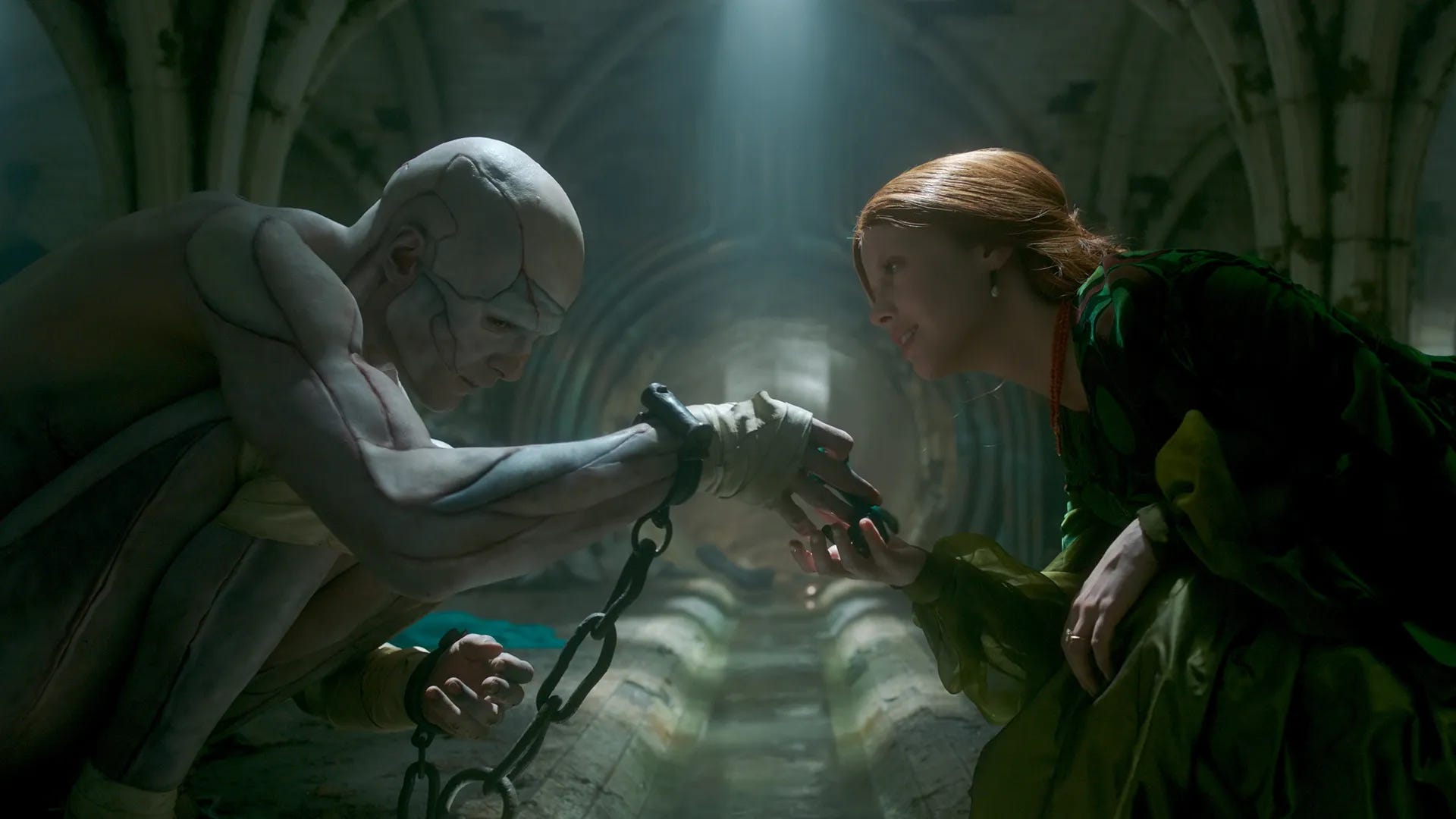
Guillermo del Toro makes films about monsters, and the twist is always the same: the grotesque character is the tender one, the “respectable” one the real brute. That’s not a criticism - plenty of artists remix the same themes over and over; such repetition can be numbing, or be, simply, deep reflection on something that matters. And heaven knows we need a conversation about the line between good and evil, and the projection of our own shadows onto others. I think Del Toro’s best film is The Devil’s Backbone, which uses the Spanish Civil War as a backdrop for a cavern-deep epic of the soul, scary and moving. An unexploded bomb in the courtyard of an orphanage full of traumatized children is emblematic of del Toro’s magnificent visual imagination; all of his films have a sense of style and place that makes them look like storybooks for grown ups. And when a character in The Devil’s Backbone transmutes their fear of a ghost once he notices a reason to empathize with the spirit, an archetypal truth is undeniable. The fact that del Toro’s films often evoke compassion makes their advocacy of retribution so confounding. The Shape of Water is, to my mind, a great film with a terrible ending: so much attention has been devoted to centering marginalized characters (a mute woman, a Black woman, a gay man, a Soviet spy and a sea monster) that the climactic vengeful killing of a mid-level bureaucrat negated the rest of the movie. And Nightmare Alley cares for the thrown-away circus acts, effectively incarcerated for the pleasure of a paying public; but has ultimately no sympathy with its protagonist who, while selfish and egotistical is also a survivor of enormous childhood trauma. You could see Nightmare Alley as a parable of what happens when a person doesn’t ask for help; but it plays more as a morality tale in which the comeuppance feels like schadenfreude rather than tragedy.
Frankenstein, del Toro’s new version of one of the most-filmed stories, is as visually inventive as any of his movies, and the director’s signature compassion is palpable in Jacob Elordi’s Creature, desperate to be loved by his Maker, and understand who he is. And the ending goes in the direction that would have made The Shape of Water a generational masterpiece. But - lamentably - unlike the Creature himself, this Frankenstein is less than the sum of its parts. The first problem is that beauty of the sets, costumes, and special effects is muted by a digital sheen that makes even grime look clean. From the opening minutes, when the crew of an ice-trapped ship are terrorized by an unknown force, and next the evocation of Kubrick’s Barry Lyndon and subtle color hints to the grandest of grand guignol, the picture looks so shiny I wanted to shield my eyes. It’s like an old table whose grain (and therefore character) has been sanded down and then lacquered; I’m sure I would have enjoyed this movie so much more if it had felt like a textured film rather than flatly varnished.
Yet there’s still heart-centered connection with vulnerable things - a character admiring butterflies, the relationship between the Creature and a blind man who takes him in; and most of all the Creature’s own agonized yearning for his father. More than most Frankenstein movies, this one has a clear sense of the scientist/re-animator’s villainy. Victor Frankenstein (Oscar Isaac) is, like the protagonist of Nightmare Alley, greedy for power and fame; also like that character, a survivor of childhood abuse whose survival has been of the most superficial kind. But the ending goes further than I recall del Toro’s films doing in the past by affirming the humanity of the bad guy; and refusing to “resolve” things with a revenge killing.
I wish I could say that I felt the story and performances up to that point were enough to make me feel the ending; but other than Elordi’s challenging and humane portrayal, and the wonderful David Bradley as the blind man, the acting here seems beholden to the same topcoat glaze as the film’s look, rather than plumbing the depths. The character emphases by otherwise wonderful actors are sincere, but I felt alienated by each of the three other main characters. Oscar Isaac’s Victor Frankenstein edges into Monty Python territory, Christoph Waltz is usually so compelling a presence that he has to compete against his own charisma to make Frankenstein’s benefactor seem distinct from so many of his other appearances, and Mia Goth doesn’t have enough material to make enough of her Elizabeth, Victor’s prospective sister-in-law who Victor wants to control as much as he does the Creature.
For a two and a half hour film, Frankenstein also takes some turns too quickly, and without attention to credible building blocks. For instance, the method by which the Creature learns to read and speak certainly makes sense, but the speed with which it happens does not (although the accent Elordi carries exactly the kind of cadences that we would expect, given the voice of the one he picked his up from). One would think that del Toro has final cut, even when working for Netflix, but there are some pacing issues that imply scenes were cut that might have served as necessary rungs on the storytelling ladder.
But the heart of the meaning of the film lingers - the desire to conquer death as a result of the loss of a mother who was the only thing protecting the child Victor from a monstrous father; an inability to cope with your creation once you realize you’re responsible for it; the way that legitimate needs can mix with crazed ambition to create a world in which everybody suffers. And, again, there’s the ending - which has the courage of compassionate conviction, despite the somewhat deflated foundation.
The theme at the heart of Frankenstein, of responsibility for your actions, and the need for love and validation, is treated with far greater subtlety in the most captivating documentary I’ve seen this year. The chilling and humane Riefenstahl, about the German filmmaker Leni Riefenstahl plunges into her life as an actor, photographer, inventor of exquisite cinematic technique, and Nazi apologist. It’s a stretch to say that she and Hitler were each other’s Frankenstein, but they each definitely played a role in “making” the other. Andres Veiel’s film is one of the most intimate documentaries ever made about an individual, not least because he had access to Riefenstahl’s recordings of private conversations. Archive footage - particularly of his subject on a 1976 TV talk show with a generational peer who resisted while Riefenstahl was frequently socializing with senior Nazi party figures - carries a grave power. The likelihood that she was horrifically treated by at least one of those men calls forth sympathy, as it should. Leni Riefenstahl was complicit in terrible things, and was apparently unable to make a full reckoning; she also seems to have held onto some dangerous beliefs. But the fragility of her later emotional state, the damage she also suffered, and the risk that singling her out absolves others of responsibility reminds us that to call her a monster risks missing the point.
Frankenstein is on Netflix; Riefenstahl is available to rent on major streaming platforms.